The EntityFieldQuery is not limited to node, it can be used to retrieve any entity types in Drupal 7. Here comes an example about getting taxonomy terms with EntityFieldQuery.
In Drupal 7, there is a user login block. We can customize that block using the hook_form_FORM_ID_alter(). You can create a custom module or implement it directly in the theme template.php.
I have a custom form and i render the form using drupal_get_form() inside the .tpl.php. One day, i find that when the submission could not pass the validation, only the failed field was highlighted but without the error message. Then i find the following post suggesting that i should called the drupal_get_form() in the .module file or preprocess function instead of the .tpl.php. form_set_error Not displaying error after invalid form submission
So i put the drupal_get_form() call in the preprocess function and set the form in the $vars so it could be printed in the .tpl.php. But that still could not solve the problem. Finally i come up with a simple solution which is just adding the following line in the .tpl.php.
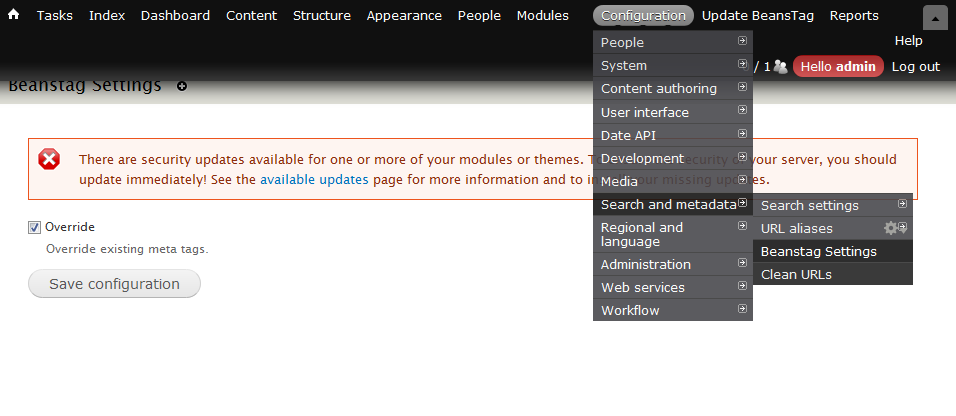
Originally, BeansTag will check if there is any existing meta tags in the page which is going to be rendered. If exists, the BeansTag module will do nothing.
As requested by a BeansTag user, recently i have added a BeansTag settings page where you disable this checking.
If this option is checked. BeansTag will override the existing meta data.
jQuery UI is included in Drupal 7 core. By default it is not included in every page, so if u want to implement those jQuery UI features, here is the little tricks you need.
Today i will continue the example written by Kevin Hankens and make the module more secure. We want to add a token in the Ajax request such that the server could check if it comes from a valid user. This token could be obtained from drupal_get_token() which will return a fixed token value for each user session. Here are the list of changes in the new eureka_ajax.module.
Set the token value in Drupal.settings in hook_init()
Add the token as query string in the theme_ajax_link()
Check if the token is valid in ajax_request_callback()
So this time we will add some access control on the above example. In Drupal 7 & 8 development, we could create new permissions by implementing the hook_permission(). After that we could modify the access arguments in the hook_menu(). Continue reading Drupal 7 – Simple Ajax implementation @ 2→

 Eureka!